



Kurikulum Berbasis Cinta dalam Membangun Solidaritas Organik dan Integrasi Moral di Madrasah Ibtidaiyah Assalam Martapura
Abstract
Penelitian ini bertujuan menganalisis kurikulum berbasis cinta di Madrasah Ibtidaiyah Assalam Martapura melalui tiga fokus utama. Penelitian ini bertujuan mendeskripsikan implementasi kurikulum berbasis cinta yang menekankan empati dan martabat peserta didik, menilai perannya dalam membangun solidaritas sosial (mekanik dan organik), serta menganalisis kontribusinya terhadap integrasi moral, pembentukan karakter, dan kesadaran sosial siswa. Penelitian ini menggunakan pendekatan kualitatif dengan desain studi kasus. Data dikumpulkan melalui wawancara mendalam, observasi partisipatif, dan studi dokumentasi, lalu dianalisis secara tematik. Hasil penelitian menunjukkan bahwa kurikulum berbasis cinta diterapkan melalui praktik nyata di kelas dan aktivitas sekolah, membangun budaya sekolah yang humanis dan inklusif. Kurikulum ini menumbuhkan solidaritas sosial melalui kerja sama, partisipasi komunitas, dan interaksi yang saling mendukung. Selain itu, kurikulum berbasis cinta berkontribusi pada integrasi moral dan pembentukan karakter, sehingga peserta didik menunjukkan sikap jujur, disiplin, peduli, dan bertanggung jawab.
Keywords
Full Text:
PDFReferences
Diaty, R., Arisa, A., Lestari, N. C. A., & Ngalimun, N. (2022). Implementasi aspek manajemen berbasis sekolah dalam pelayanan bimbingan dan konseling. Jurnal Bimbingan Dan Konseling Pandohop, 2(2), 38-46.
Durkheim, É. (1982). The rules of sociological method (W. D. Halls, Terj.). The Free Press.
Edmondson, A. C. (1999). Psychological safety and learning behavior in work teams. Administrative Science Quarterly, 44(2), 350-383.
Edmondson, A. C. (2018). The fearless organization: Creating psychological safety in the workplace for learning, innovation, and growth. Hoboken, NJ: Wiley.
Erawati, D. (2017). Interpretasi multikulturalisme agama dan pendidikan. Jurnal Studi Agama Dan Masyarakat, 13(1), 100-119.
Hadi, M. S., Veri Setiawan, & Putri Maulidiah Hidayah. (2025). The Effect of Implementing Deep Learning on Improving Students’ Cognitive Abilities in the Independent Curriculum at Yogyakarta High Schools. Journal of Research in Islamic Education, 7(1), 270–282.
Hargreaves, A., & Fullan, M. (2012). Professional capital: Transforming teaching in every school. New York, NY: Teachers College Press.
Hilmy, M. (2003). Menggagas Paradigma Pendidikan Berbasis Multikultural. Ulumuna, VII, 12.
Hooks, B. (2003). Teaching community: A pedagogy of hope. New York, NY: Routledge.
Iqbal, M., Ansari, B. I., & Fitriati. (2025). Kurikulum Cinta Dan Deep Learning Untuk Penguatan Kompetensi Guru Dalam Ekosistem Religius, Kritis Dan Adaptif. Jurnal Akselerasi Merdeka Belajar Dalam Pengabdian Orientasi Masyarakat (AMPOEN): Jurnal Pengabdian Kepada Masyarakat, 3(2), 201-208.
Islam, M. T., Azmi, M. U., Ikmah, A. D., Mushaffa, A., Saidou, O., & Novitasari, D. (2025). An Analysis of KH. Ahmad Dahlan’s Thought in Islamic Education and its Relevance in 21st-Century Learning. Tarbawi Ngabar: Jurnal of Education, 6(1), 1-37.
Latifah, L., & Ngalimun, N. (2023). Pemulihan Pendidikan Pasca Pandemi Melalui Transformasi Digital Dengan Pendekatan Manajemen Pendidikan Islam Di Era Society 5.0. Jurnal Terapung: Ilmu-Ilmu Sosial, 5(1), 41-50.
Lovat, T., & Toomey, R. (2009). Values education and quality teaching: The double helix effect. Dordrecht: Springer.
Ngalimun. (2014). Strategi dan model pembelajaran. Yogyakarta: Aswaja Pessindo.
Ngalimun, N. (2022). Bahasa Indonesia Untuk Penulisan Karya Ilmiah. EduCurio: Education Curiosity, 1(1), 265-278.
Noddings, N. (2005). The challenge to care in schools: An alternative approach to education (2nd ed.). New York, NY: Teachers College Press.
Nofirman. (2025). Implementation of Deep Learning Curriculum in STEM Education: A Case Study in Secondary Schools in Bengkulu. International Journal Education and Computer Studies (IJECS), 5(2), 61-73.
P.A.J. Waddington, Tom R. Tyler (2011). Why People Cooperate: The Role of Social Motivation, Policing: A Journal of Policy and Practice, Volume 7, Issue 1, March 2013, Pages 109-112
Prihantini, P., Sutarto, S., Apriliyani, E. S., Stavinibelia, S., Arsyad, M., & Mukhtar, D. (2025). Deep Learning Approaches in Education: A Literature Review on Their Role in Addressing Future Challenge. TOFEDU: The Future of Education Journal, 4(5), 1213–1220.
OECD. (2018). Social and emotional skills for student success. Paris: OECD Publishing.
Qodir, A. (2025). Penerapan Kurikulum Berbasis Cinta Pada Mata Pelajaran Pendidikan Agama Islam di MIN 12 Banjar Kabupaten Banjar. Masca: Journal of Islamic Studies, 1(3), 1-9.
Riinawati, N. (2022). Implementation of Character Education in Islamic Perspective at School. Journal of Positive Psychology and Wellbeing, 6(1), 561-566.
Roisyah, H., Hannani Roisyah, & Muhamad Ansori. (2024). Implementation Of The Taba Curriculum Model In Character Education Via Reflective Logbooks At MTS Al Qodiri. Journal of Islamic Education Studies, 1(2), 44–51
Ryan, R. M., & Deci, E. L. (2000). Intrinsic and extrinsic motivations: Classic definitions and new directions. Contemporary Educational Psychology, 25(1), 54-67.
Salas-Pilco, S. Z., Xiao, K., & Hu, X. (2022). Artificial Intelligence and Learning Analytics in Teacher Education: A Systematic Review. Education Sciences, 12(8), 569
Sergiovanni, T. J. (2000). The lifeworld of leadership: Creating culture, community, and personal meaning in our schools. San Francisco, CA: Jossey-Bass.
Slavin, R. E. (2014). Cooperative learning and academic achievement: Why does groupwork work? Anales de Psicología, 30(3), 785-791.
Suprapti, S., Ilmiyah, N., Latifah, L., & Handayani, N. F. (2022). Islamic Aqidah Learning Management to Explore the Potential of Madrasah Students. Budapest International Research and Critics Institute-Journal (BIRCI-Journal), 5(1), 4664-4673.
Suyanto, & Hisyam, D. (2018). Pendidikan karakter: Teori dan aplikasi. Jakarta: Rineka Cipta.
Tong, C., Ren, C. (2025) Deep knowledge tracing and cognitive load estimation for personalized learning path generation using neural network architecture. Sci Rep 15, 24925
Vygotsky, L. S. (1978). Mind in society: The development of higher psychological processes. Harvard University Press
Whitehead, A. N. (1967). The aims of education and other essays. Free Press.
Wentzel, K. R. (2009). Students’ relationships with teachers as motivational contexts. Dalam K. R. Wentzel & A. Wigfield (Ed.), Handbook of motivation at school (hlm. 301-322). New York, NY: Routledge.
Yin, R. K. (2018). Case Study Research and Applications: Design and Methods (6th ed.). SAGE.
Zakiyah, Q. Y., & Rusdiana, A. (2014). Pendidikan nilai: Kajian teori dan praktik di sekolah. Bandung: Pustaka Setia.
Zins, J. E., Weissberg, R. P., Wang, M. C., & Walberg, H. J. (2004). Building academic success on social and emotional learning. New York, NY: Teachers College Press.
Zurqoni, Retnawati, H., Apino, E., & Anazifa, R. D. (2018). Impact of character education implementation: A case study in Indonesia. Journal of Social Studies Education Research, 9(3), 203-221.
Zwagery, R. V., Safithri, E. A., & Latifah, N. (2020). Psikologi Perkembangan: Konsep Dasar Pengembangan Kreatifitas Anak. Yogyakarta: Parama Ilmu.
DOI: http://dx.doi.org/10.61590/int.v4i01.219
Refbacks
- There are currently no refbacks.
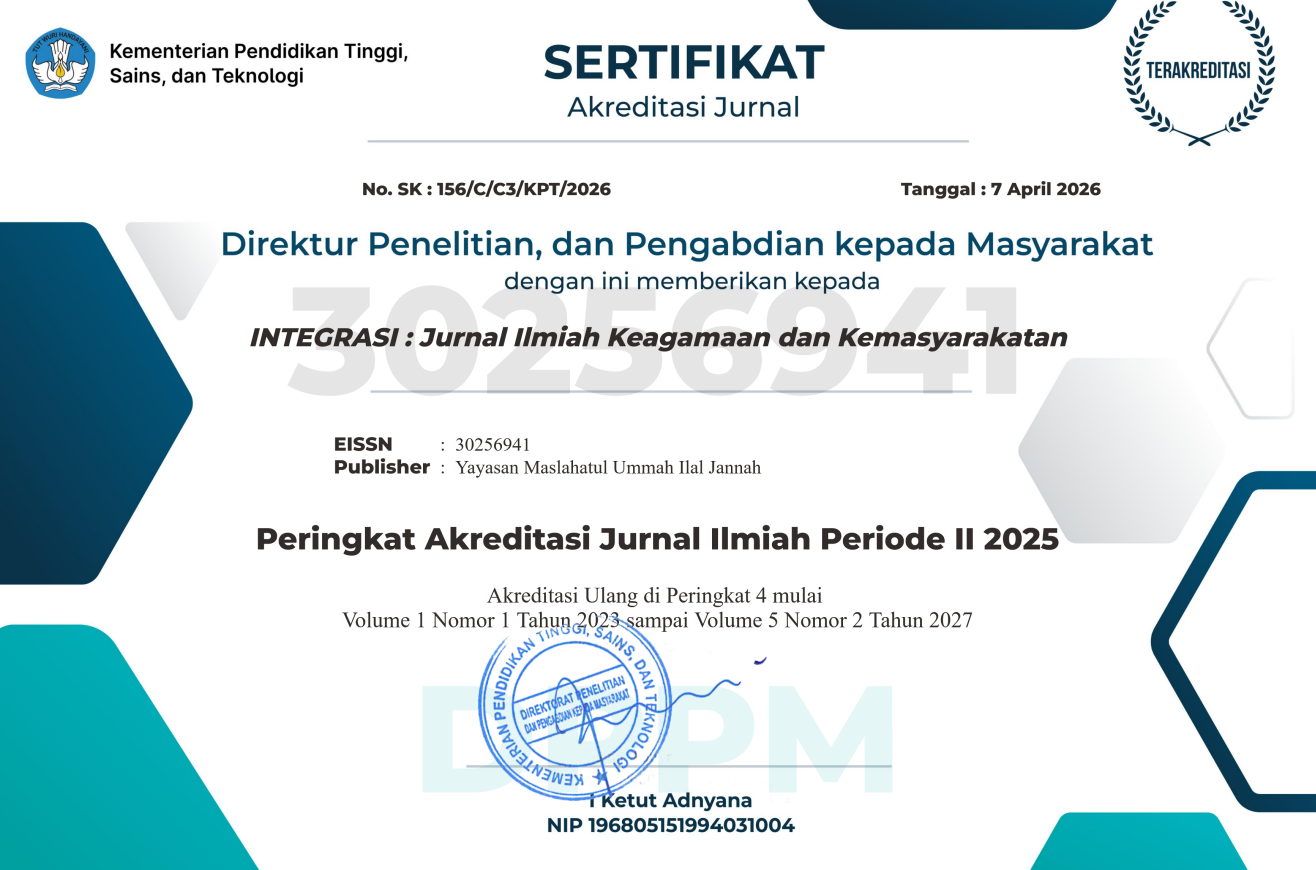
INTEGRASI : Jurnal Ilmiah Keagamaan dan Kemasyarakatan
index by:





Jl. Norman Umar No. 117 Rt. 7 Kelurahan Kebun Sari Kecamatan Amuntai Tengah Kabupaten Hulu Sungai Utara Kode Pos 71415. Email: integrasijurnal@gmail.com

This work is licensed under a Creative Commons Attribution 4.0 International License.
View My Stats